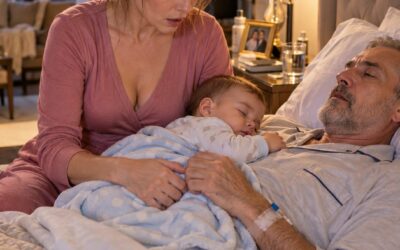
“Could Claire have survived longer than I was told?”
Keller’s face softened with something close to sorrow.
“No, Daniel. I reviewed her final medical report myself.”
The hope vanished as quickly as it had come.
“Then who survived?”
“I don’t know.”
A knock sounded at the library door.
Security spoke from the hallway.
“Mr. Whitfield, Ms. Alvarez needs you.”
I opened the door.
Maria stood there holding Sophia’s wooden box.
Her face had lost all color again.
“I found the key,” she said.
She held up a small brass key tied to a faded blue ribbon.
Keller stared at it.
“Where was it?”
“Inside the lining of the box.”
I took it from her.
A number had been engraved along the shaft.
Keller stepped closer.
“That is not a bank-deposit key.”
“You recognize it?”
“It is from Bellwether House.”
“How can you be sure?”
“The patient rooms used brass keys before the renovation. Each one was engraved.”
“Room 214?”
Keller nodded.
Maria looked between us.
“Bellwether closed two years ago.”
“No,” Keller said. “The medical wing closed. The residential building was sold.”
“To whom?” I asked.
He hesitated before answering.
“To a charitable foundation.”
“What foundation?”
Keller reached for one of the files and turned several pages.
Then he placed a document on the desk.
At the bottom was the name of the organization that had purchased Bellwether.
The Claire Whitfield Family Foundation.
I stared at the page.
“That is impossible. I created the foundation after Claire died.”
“Yes,” Keller said quietly. “But according to the property records, the purchase was authorized three months before her death.”
I looked at the signature.
It was mine.
Not similar to mine.
Mine.
Yet I had never seen the document in my life.
Maria crossed her arms tightly.
“Someone signed for you.”
“No,” I said.
The memory came slowly.
Stacks of papers placed in front of me during Claire’s treatment. Trust documents. Medical authorizations. Estate amendments. I had signed wherever the attorneys marked with yellow tabs.
Lost in fear, I had barely read them.
“Claire arranged it,” I whispered.
Keller nodded.
“She may have intended Bellwether to become a safe place for the surrogate and the baby.”
“Then why was Sophia brought to Maria?”
“Because something changed.”
A soft sound came from the doorway.
Sophia stood there in her pajamas, clutching her one-eared rabbit.
Maria turned quickly.
“You were supposed to stay in the kitchen.”
“I heard the music.”
“What music?”
Sophia pointed toward the wooden box.
The lullaby had begun playing again, though no one had opened the lid.
Maria set it on the desk.
The tune slowed, warped by the aging mechanism, then stopped.
A click came from beneath the velvet lining.
A narrow compartment slid open.
Inside was a photograph.
I picked it up.
Claire stood in the garden at Bellwether, thinner than I remembered, wearing a scarf over her hair. Beside her was Elena.
Between them stood a third woman, visibly pregnant.
The surrogate.